


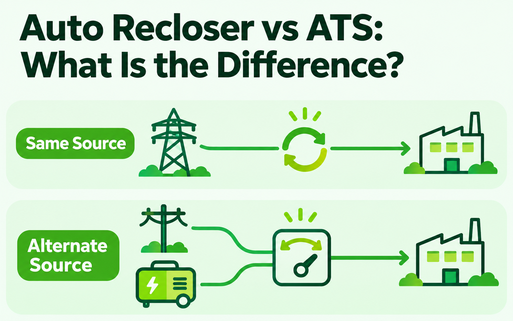
Auto recloser vs ATS is a common source of confusion because both devices can help restore power. However, they act at different points in the electrical system and respond to different events.
An automatic recloser operates a protective circuit after a permitted trip. An automatic transfer switch moves a load from one power source to another. Some critical sites need both functions.
Auto Recloser vs ATS
| Item | Auto Recloser | ATS |
|---|---|---|
| Main job | Restore a protected circuit | Transfer a load between sources |
| Typical trigger | Breaker or RCCB trip | Normal source failure or abnormality |
| Energy source | Usually the same supply | Normal and alternate sources |
| Protection role | Works with the protective breaker | Does not replace branch overcurrent protection |
| Recovery decision | Trip source, fault check, retry, lockout | Source voltage, frequency, delay, transfer logic |
What an Auto Recloser Does
An auto recloser adds an actuator and controller to a compatible protective device. After an eligible trip, it evaluates the condition, waits for a defined period, and may close the same circuit again.
The purpose is continuity after a temporary event. If the fault continues, the system should stop retrying and enter lockout. Manual opening and maintenance lock should also inhibit restoration.
Read Auto Recloser vs Circuit Breaker for a detailed explanation of the protective relationship.
What an ATS Does
An ATS monitors the normal and alternate power sources. When the normal source fails or falls outside permitted limits, the ATS initiates a sequence that connects the load to the alternate source. It may also signal a generator to start.
IEC 60947-6-1:2026 covers transfer switching equipment within its stated scope, including automatic transfer switching equipment and controllers. The standard describes equipment used to transfer a load between power sources.
An ATS must prevent unacceptable source connection states and must have suitable current and fault-withstand ratings. It is not simply two breakers with an informal software rule.
Why One Device Cannot Replace the Other
Suppose utility power fails. A branch auto recloser cannot create an alternate source. An ATS can transfer the load to a generator or second supply.
Now suppose one branch breaker trips because of a local circuit condition while utility power remains normal. Transferring the whole site to another source does not remove that branch fault. The branch protection still needs diagnosis, and an eligible circuit may need separate reclosing logic.
Therefore, the two functions should be coordinated but not confused.
When a Project Needs Both
A telecom site, data system, remote utility station, or critical commercial facility may use an ATS at the incomer and automatic reclosers on selected outgoing circuits.
The ATS maintains access to an available power source. The reclosers manage recovery of individual branches. Meanwhile, a controller or BMS supervises priorities, alarms, and operating permissions.
Coordination is important during source transfer. Branch devices should not reclose while voltage is unstable or while the ATS sequence is incomplete. In addition, restoration may need staged delays to avoid a sudden load step on a generator.
Matismart Reclosing Options
The Matismart MT56 series works with compatible MCBs, RCCBs, and RCBOs and offers fault identification plus communication variants. The MT53RV adds RS485 control and voltage-recovery logic for selected low-voltage applications.
These devices operate protected circuits. They should be coordinated with, not described as a replacement for, the site’s approved ATS and source-transfer equipment.
Coordinate Restoration Delays and Load Priority
When both systems are installed, sequence matters. The ATS should first confirm that the alternate or restored source is acceptable. Branch devices can then restore selected loads in stages.
A staged sequence prevents every motor, rectifier, charger, or power supply from starting at the same moment. It also allows the site controller to keep noncritical loads open when generator capacity is limited.
Document which controller owns each decision. The ATS controller should manage source transfer. The branch controller should manage permitted circuit restoration. The BMS or PLC may coordinate priorities, but its communication failure should not remove essential local protection.
During commissioning, test loss of the normal source, failure of the alternate source, return to normal, and a separate branch trip. Each event should produce a distinct and understandable response.
Event records should use synchronized time so the team can reconstruct the sequence. Without accurate timestamps, an ATS transfer and a branch trip may appear related even when they occurred for different reasons.
Frequently Asked Questions
Is an auto recloser the same as an ATS?
No. A recloser restores a protected circuit after an eligible trip. An ATS transfers a load between normal and alternate sources.
Can an ATS reset a tripped branch breaker?
Normally, no. It manages source transfer. A branch breaker and its control system remain responsible for the branch circuit.
Can an auto recloser switch to a generator?
Not by itself. Generator source transfer requires properly designed transfer switching equipment and control logic.
Why would a site use both devices?
The ATS keeps an available source connected, while reclosers support selected branch-circuit recovery. Together they address different causes of downtime.
Should branch reclosers operate during ATS transfer?
The site sequence should prevent uncoordinated operation. Voltage stability, source availability, generator capacity, and staged load restoration may all matter.
Identify the Event Before Choosing the Device
The auto recloser vs ATS decision becomes simple when the problem is clear. Use an ATS for source availability. Use a suitable auto recloser for controlled restoration of an eligible protected circuit.
Explore Matismart automatic reclosers and remote controllers, or share the single-line diagram and required operating sequence for a design-in review.