


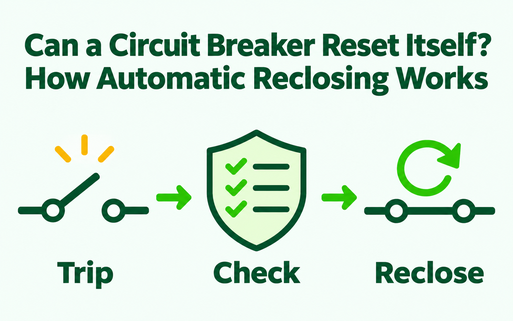
Can a circuit breaker reset itself? A standard circuit breaker usually cannot. It opens during a fault and remains open until someone operates it. However, a compatible automatic reclosing device can move the breaker after defined safety checks.
This does not mean the system should reset every trip. The controller must decide whether the opening came from a temporary event, a continuing fault, a manual action, or a maintenance command.
Can a Circuit Breaker Reset Itself?
The answer depends on the equipment. A conventional MCB, RCCB, or RCBO has no motor and no reclosing controller. Therefore, it cannot return to ON by itself.
An automatic-reset arrangement adds several parts:
- A breaker suitable for the circuit
- A motorized operating mechanism
- Position or trip feedback
- A controller with reclosing logic
- Optional insulation, leakage, or voltage checks
- Auto, manual, and lock operating modes
Some products combine these parts. Others use a separate module beside a compatible breaker.
What Happens After a Trip?
A safe sequence starts by identifying the event. The controller should not assume that every open breaker represents the same condition.
| Open Condition | Typical Response | Reason |
|---|---|---|
| Manual opening | Remain open | A person may intend isolation |
| Temporary permitted event | Check, wait, then reclose | Restore service after recovery |
| Continuing fault | Lock out | Prevent repeated energization |
| External emergency trip | Remain open until authorized reset | Emergency command has priority |
| Maintenance lock | Block motor and remote command | Avoid unexpected energization |
How Fault Checking Improves Safety
Different products use different methods. Some test insulation before closing. Some monitor residual current. Others make a limited closing attempt and identify a permanent fault if the breaker trips again immediately.
The Matismart MT56, for example, distinguishes manual, nuisance, and permanent fault conditions. If the matched breaker trips again within the product’s defined window after reclosing, MT56 enters lockout for inspection.
By contrast, the MT53SD includes insulation detection before permitted restoration. The correct approach depends on the circuit, breaker type, load, and required standard.
Why Retry Limits Matter
Repeated closing into a permanent fault is not a repair strategy. Therefore, the controller needs a maximum attempt count and a defined lockout state.
The software should show the reason for lockout, the number of attempts, and the action required. A remote reset should not erase the need to investigate a repeated trip. If the cause is unknown, keep the circuit out of service and have a qualified technician investigate before restoring power.
Where Automatic Reset Can Add Value
Automatic restoration can reduce downtime at unattended or difficult-to-reach sites. Common examples include telecom cabinets, traffic systems, outdoor lighting, pumps, network equipment, photovoltaic systems, and EV infrastructure.
However, the load must tolerate automatic restart. Rotating machinery, heating equipment, maintenance areas, and circuits with people nearby may need extra interlocks or may not suit automatic reclosing at all.
Automatic Reset Is Not Maintenance Isolation
A selector marked manual or OFF is not automatically a safe work isolation point. Local procedures must prevent remote or automatic energization and verify the deenergized condition.
The OSHA requirements for electrical work practices state that control circuit devices and interlocks cannot serve as the sole means of deenergizing equipment. Local regulations may impose additional requirements.
In addition, check the load’s behavior after restoration. Some devices start immediately when power returns. Others need a separate control command. The circuit may be electrically ready even when the connected process is not ready to restart.
For motors, pumps, heaters, and machinery, separate permission to close the breaker from permission to start the process. This approach lets the electrical system restore safely while the process controller keeps the equipment stopped until its own interlocks are satisfied.
Document both sequences during commissioning so operators understand what automatic reset will and will not do.
What to Check During Commissioning
First, operate the breaker locally and confirm that the controller recognizes manual opening. It should not immediately reverse the operator’s action. Then test automatic mode with the permitted simulated event described in the product instructions.
Next, test a blocking condition. This may be a maintenance lock, failed insulation check, external trip, or another state supported by the device. The actuator must remain inactive and the reason should be visible.
Finally, verify the failed-reclose response. Confirm the retry count, lockout indication, remote status, and manual reset procedure. Record the approved settings in the panel documentation.
These tests show whether the complete system follows the intended logic. They are more useful than checking only whether the motor can move the handle.
Frequently Asked Questions
Do normal household breakers reset automatically?
No. A standard breaker stays open after it trips. Automatic reset requires a compatible reclosing device or an integrated product.
Why would a breaker reset itself?
The purpose is to restore service after an approved temporary condition at an unattended site. It should not hide a permanent fault.
Can a self-resetting breaker keep trying forever?
No. A suitable controller limits retries and locks out when the fault continues or the operation fails.
Will a manual OFF command be automatically reversed?
It should not be. The system needs to distinguish manual opening from an event that permits automatic restoration.
Is an automatic reset breaker safe for maintenance?
Only when it is placed in the approved local lockout state and the site’s isolation procedure is followed. Automatic control alone is not lockout/tagout.
Reset Only After a Defined Decision
So, can a circuit breaker reset itself? It can when suitable hardware and logic are added. Yet the important question is whether the circuit is allowed to re-energize after that specific event.
See the Matismart introduction to automatic reclosers, or compare the full recloser and remote-controller range.