


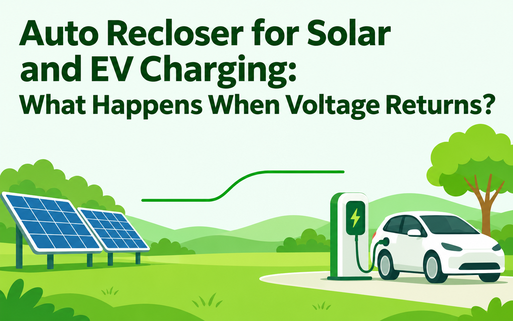
An auto recloser for solar may restore a PV or EV charging circuit after the supply voltage returns to an acceptable range. However, voltage recovery alone does not prove that every part of the system is ready to reconnect.
The project must coordinate the breaker, voltage protection, inverter or charger, anti-islanding behavior, delay, retry limit, and maintenance controls.
Why Solar and EV Circuits Disconnect
A PV inverter or EV charger may stop during voltage loss, undervoltage, overvoltage, frequency problems, internal faults, or commands from another protection system.
A circuit breaker may also open because of overload, short circuit, residual current, or a manual action. These events do not have the same recovery logic.
Therefore, the controller should not treat every open circuit as a simple grid-voltage interruption. It must identify which device operated and why.
How an Auto Recloser for Solar Works
A voltage-supervised recloser monitors the supply. When voltage moves outside the defined limits, it opens the matched protective device. After voltage returns to the acceptable band and remains stable for the required delay, the controller may close the circuit.
| Event | Possible Action | Before Restoration |
|---|---|---|
| Grid voltage loss | Open or remain disconnected | Voltage stable and anti-islanding sequence complete |
| Overvoltage or undervoltage | Trip at configured product threshold | Recovery threshold and delay satisfied |
| Overcurrent or short circuit | Breaker protection opens | Fault investigation or eligible reclose logic |
| Residual-current trip | RCCB or RCBO opens | Leakage or insulation condition assessed |
| Manual or maintenance OFF | Remain open | Authorized local release |
Anti-Islanding and Reclosing Are Related but Different
Anti-islanding functions prevent a grid-connected generation system from continuing to energize an isolated utility section under prohibited conditions. Automatic reclosing restores a local switching device after recovery.
As a result, the recloser should not bypass the inverter’s anti-islanding and grid-code functions. Instead, it should coordinate with them. The final design must follow local utility rules, inverter instructions, and applicable installation standards.
Why a Recovery Delay Matters
Voltage may return briefly and then fail again. A delay helps confirm that the supply has stabilized before the circuit is energized.
The delay also supports staged restoration. At a site with several chargers or inverters, closing every circuit at the same moment may create a large inrush or load step. Therefore, the controller may need different delays for different branches.
The Matismart MT53PV is designed for selected PV and charging applications. It provides overvoltage, undervoltage, voltage-loss protection, automatic recovery, and a defined closing delay. Confirm the current manual, voltage system, matched breaker, and local requirements before selection.
EV Charging Adds Load-Control Questions
An EV charger may have its own contactor, residual-current monitoring, communication, and restart sequence. Re-energizing its upstream circuit does not guarantee immediate charging.
The energy management system may also impose a load limit. Therefore, after voltage returns, the site may need to restore chargers in stages and re-authorize charging according to available capacity.
For branches that require remote ON/OFF commands, check the control interfaces and breaker compatibility of the Matismart MT53R.
Define the Boundary Between Devices
The recloser should not duplicate every inverter or charger function. Instead, the project should define which device owns voltage supervision, residual-current protection, anti-islanding, contactor control, branch isolation, and remote commands.
Also confirm what happens when two devices want different states. For example, the branch recloser may be ready while the inverter still requires a grid-observation delay. In that case, the inverter’s start permission remains part of the sequence.
For EV charging, the upstream breaker may be closed while the charger keeps its internal contactor open. The energy management system can then release charging after capacity becomes available.
A clear responsibility matrix avoids false assumptions and helps the commissioning team test each layer separately.
Include the maintenance modes in that matrix. A local technician must be able to prevent reconnection while working on the PV, charger, breaker, or cable, even if voltage recovers or the remote platform sends a command.
Test that condition before handover.
Block Closing During Fault and Maintenance States
A voltage recovery event should never override a manual opening, maintenance lock, fire command, continuing breaker fault, or failed actuator. The product also needs a retry limit and a visible lockout after repeated failure.
For work on the circuit, follow the approved isolation procedure. The OSHA electrical work-practice rules explain why control functions cannot serve as the sole means of deenergization.
Frequently Asked Questions
Can a solar breaker reconnect when grid voltage returns?
It can when suitable voltage-supervised hardware permits it. The inverter, utility rules, anti-islanding sequence, delay, and other protections must also allow reconnection.
Does an auto recloser replace inverter anti-islanding?
No. Reclosing control and inverter anti-islanding serve different functions and must be coordinated.
Why should the recloser wait after voltage recovery?
The delay confirms that voltage is stable and can help stage the restoration of several loads or generation branches.
Can the same device protect against short circuit and abnormal voltage?
The recloser may add voltage supervision, but a suitable breaker still provides the required overcurrent protection. Verify the complete combination.
Is an auto recloser suitable for every EV charger?
No. Check charger instructions, residual-current protection, restart behavior, load management, local regulations, and the matched switching device.
Coordinate the Entire Recovery Sequence
An auto recloser for solar should restore power only after the supply, protection, inverter or charger, and site controls agree that reconnection is permitted.
Explore the MT53PV voltage recloser and Matismart recloser range, or provide the single-line diagram and recovery sequence for review.