


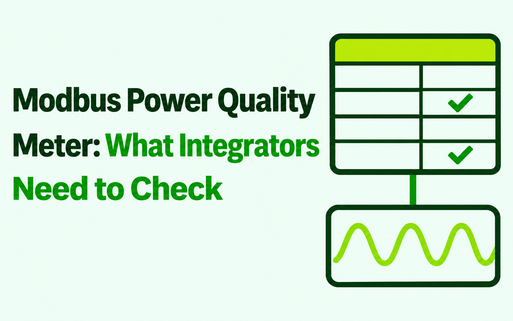
A Modbus power quality meter can connect detailed electrical data to a BMS, SCADA, PLC, EMS, or industrial IoT platform. However, the word Modbus does not tell the integrator which values the meter measures.
One meter may expose basic voltage, current, power, and energy registers. Another may add harmonics, unbalance, demand, alarms, voltage events, and waveform records.
Therefore, engineers should evaluate the measurement functions and the communication documents together.
What Is a Modbus Power Quality Meter?
A Modbus power quality meter is an electrical measuring device that uses the Modbus application protocol to exchange data with another system.
The Modbus Application Protocol Specification describes Modbus as an application-layer messaging protocol. It uses function codes and a request-response model.
However, Modbus does not define the product register addresses or the meaning of every data point. The manufacturer must provide that information.
Modbus RTU vs Modbus TCP
First, confirm which implementation the project needs.
| Item | Modbus RTU | Modbus TCP |
|---|---|---|
| Typical interface | RS485 serial | Ethernet |
| Device identification | Serial device address | IP address and unit context |
| Network design | Bus topology and termination | Switches, subnets, and IP planning |
| Common use | Field-level meter network | Direct connection to IP systems |
| Main planning issue | Baud rate and bus loading | Clients, polling, and cybersecurity |
Modbus RTU does not always mean RS485, although that combination is common. Likewise, Ethernet does not automatically mean Modbus TCP. Confirm both the physical interface and the protocol.
Ask for the Complete Register Map
Next, request the protocol document before approving the device. A useful register map should show:
- Register address
- Register type
- Supported function code
- Data length
- Signed or unsigned format
- Integer or floating-point format
- Byte and word order
- Scaling factor
- Engineering unit
- Read or write permission
- Valid range
- Firmware and protocol version
A brochure that only states “Modbus supported” is not enough for engineering integration.
Check Data Types, Scaling and Byte Order
Many integration errors come from interpreting a correct response in the wrong format.
For example, one voltage value may use a 16-bit integer with a scale of 0.1. Another may use a 32-bit floating-point value across two registers.
In addition, devices may use different byte or word orders. Therefore, compare the software value with the local meter display during commissioning.
Separate Real-Time Values from Events
Real-time parameters usually fit normal register polling. Event records may require a different method.
Before selection, ask:
- Can Modbus read the latest alarm and event status?
- Can the software retrieve historical events?
- Are event timestamps available?
- Can the system access harmonic arrays?
- Can it retrieve waveform records?
- Does the meter require a web page, USB export, or dedicated software for detailed records?
This distinction matters because Modbus support does not guarantee access to every function shown on the local display.
Plan Read and Write Permissions
A monitoring project may only need read access. However, some meters also allow remote changes to thresholds, communication settings, demand resets, or other parameters.
Therefore, document every writable register. Limit write access to approved controllers and users. In addition, define how the project will restore the configuration after replacement or maintenance.
Test a Sample Before Site Deployment
Before a large rollout, connect one sample meter to the intended controller or software. Read known values and compare them with the local display.
Next, test phase mapping, CT ratio, energy direction, harmonics, alarm status, and communication recovery. If the project uses writable registers, verify them in a controlled test environment. This sample test can reveal register offsets, data-format errors, or firmware differences before they affect many installed devices.
Build a Practical BMS Point List
Do not import every available register. Instead, select points that support operation and decisions.
- Voltage and current by phase
- Active, reactive, and apparent power
- Power factor and frequency
- Energy and demand
- Voltage and current unbalance
- THD and selected harmonics
- Minimum and maximum values
- Alarm and event status
- Communication health
Then assign a suitable polling interval to each group. Fast values, trends, energy totals, and configuration do not need the same update rate.
Matismart Modbus Power Quality Meter Options
The PEM5000 supports Modbus RTU over RS485 and Modbus TCP over Ethernet. It combines real-time measurement with harmonics, unbalance, waveform views, voltage events, display, and local storage.
The PEM3000 supports RS485 Modbus RTU for three-phase power, energy, demand, unbalance, and harmonic monitoring.
For multi-circuit applications, the MPM4000 provides RS485 and Ethernet communication for several feeders.
For physical network planning, read the RS485 integration guide or the Ethernet power quality meter guide.
Frequently Asked Questions
Does every Modbus power quality meter use RS485?
No. Modbus RTU commonly uses RS485, while Modbus TCP normally uses Ethernet. Confirm the interface and protocol separately.
Can Modbus read harmonic data?
Yes, if the meter measures harmonics and exposes them through documented registers. Modbus itself does not create harmonic measurement capability.
Why do I need a register map?
The register map tells the software where each value is stored and how to interpret it. Without it, reliable integration is not possible.
Can a Modbus meter send alarms automatically?
Traditional Modbus usually works through polling. Alarm handling depends on the meter, controller, gateway, and software design.
Can one Modbus power quality meter connect to several systems?
Possibly. Modbus TCP may allow several clients, while an RTU device normally has one polling controller on the bus. Confirm the product and architecture limits.
Verify the Data Path Before Site Commissioning
A Modbus power quality meter is not fully specified until the project confirms the interface, register map, data format, permissions, and software mapping.
Send Matismart the required parameters, protocol type, point list, and target software. Our team can support device selection and register review before sample testing.