


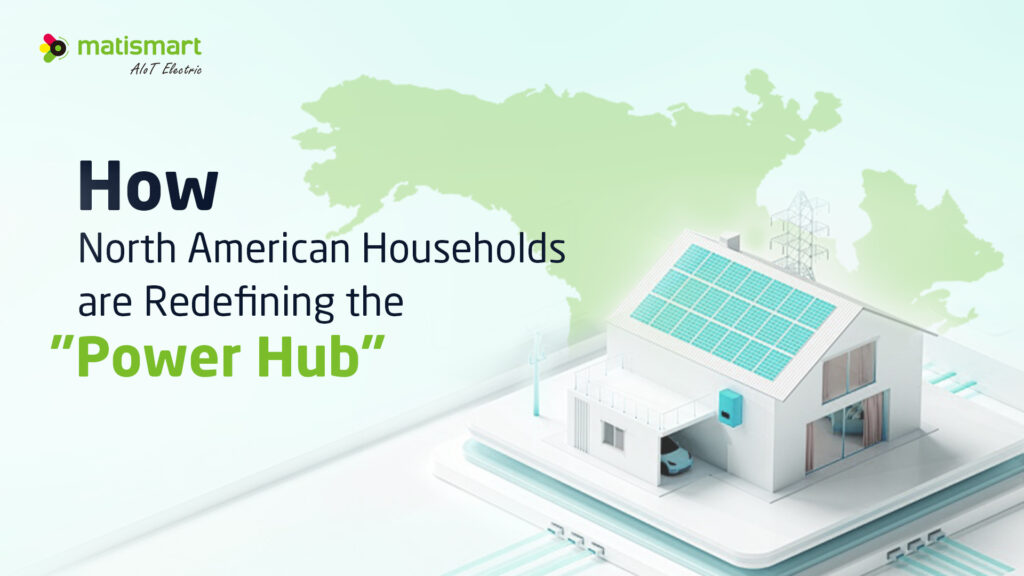
In the current global energy transition, the North American residential market is undergoing a concrete and "hardcore" transformation. This isn't just a conceptual upgrade; it is a commercially proven loop driven by high-load, multi-source power environments.
To be clear: the technical paths and application scenarios discussed here are rooted in the specific residential structures and energy profiles of North America. While they may not be a direct template for every market, they serve as the premier blueprint for observing how energy systems evolve from "passive distribution" to "active optimization."
From "Safety First" to "Efficiency Always"
For decades, the demand for residential distribution panels in North America was simple: stay stable, stay safe, and don't trip. The panel was like plumbing—invisible until something went wrong.
However, as solar penetration rises, home storage becomes mainstream, and Electric Vehicles (EVs)—the ultimate "power beasts"—enter the garage, traditional systems are facing an unprecedented risk of losing control. When solar, batteries, the grid, and high-power loads converge in a single box, a "dumb" metal enclosure is no longer sufficient.
Today, the market is shifting away from the term "Smart Circuit Breaker" toward the Energy Hub. This signifies a fundamental shift in the panel’s role: from a "Safety Gatekeeper" to an "Energy Dispatcher."
The Truth Behind the Data: Decision Power Trumps Sensing
While many believe the core of intelligence is data, real-world applications prove that data alone is too slow for decision-making.
When sampling rates hit 24,000 times per second and metering achieves revenue-grade accuracy (0.5), the underlying logic is to enable data to participate directly in control. In North America, users no longer ask "How much power did I use?" but rather, "Between my EV, HVAC, and heat pump, who gets the power right now?"
If a system cannot handle these "multiple-choice questions," the result is frequent tripping or hardware strain. True intelligence lies in the ability to perform real-time priority dispatching, ensuring that critical loads—like refrigeration, networking, and lighting—remain online at all times.
Energy Resilience: Outages as a "State Switch," Not an "Anomaly"
Against a backdrop of increasingly frequent extreme weather, "Energy Resilience" has moved from industry jargon to a baseline requirement. Leading North American systems now achieve grid-to-off-grid switching in tens of milliseconds—virtually imperceptible to the user.
More importantly, this switch is accompanied by sophisticated Asset Management. The system dynamically sheds non-essential loads based on the battery’s State of Charge (SoC). This proactive management transforms electricity from a binary "on/off" resource into a managed asset.
Software-Defined Capacity: The Efficiency Revolution
A major takeaway from the North American market is this: If a problem can be solved with code, no one wants to tear out walls to change wires.
Through Power Control Systems (PCS), these hubs can manage whole-home loads in real-time to significantly increase EV charging speeds without upgrading the physical service entrance or the distribution panel. Essentially, software algorithms are unlocking "buffer capacity" that was previously idle and turning it into a controllable dispatching capability.
Conclusion: Whoever Owns the "Dispatch Rights" Owns the Future
Whether the hardware is an EV, a battery, an inverter, or a smart switch, the ultimate battlefield is the same: the dispatch rights of home energy.
The North American evolution shows that systems inevitably follow a trajectory: Passive Distribution → Energy Sensing → Energy Management → Energy Optimization. This evolution is not about a single device; it is about the systemic ability to orchestrate power with precision.
As thousands of these Energy Hubs connect, every home and campus ceases to be a mere consumer. They become micro-nodes capable of regulating the grid and creating value. This is the "next layer" of logic driving the energy revolution.