


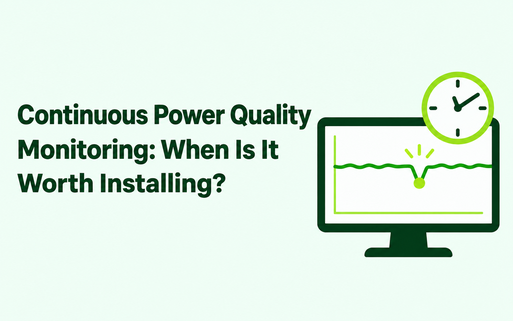
Continuous power quality monitoring creates a permanent record of how an electrical system operates over time. It can reveal disturbances that do not appear during a short inspection.
For example, a production trip may occur once every two weeks. A voltage dip may last less than a second. Harmonic levels may rise only when a specific drive or inverter operates.
Therefore, one manual reading cannot describe the complete condition. A fixed monitoring system can connect electrical events with equipment operation, time, and location.
What Is Continuous Power Quality Monitoring?
Continuous power quality monitoring uses permanently installed meters to collect electrical data at defined intervals and record selected events.
Depending on the device, the system may track:
- Voltage and current trends
- Frequency
- Demand and power factor
- Voltage and current unbalance
- Total harmonic distortion
- Individual harmonic orders
- Voltage dips, swells, and interruptions
- Minimum and maximum values
- Waveforms and event timestamps
- Energy and operating load
The meter may store data locally or send it to BMS, SCADA, EMS, DCIM, or dedicated monitoring software.
Continuous Monitoring vs a Portable Power Quality Survey
Both methods have value. However, they answer different questions.
| Requirement | Continuous Monitoring | Portable Survey |
|---|---|---|
| Monitoring period | Ongoing | Temporary |
| Best use | Trends, alarms, recurring events | Focused engineering investigation |
| Installation | Fixed panel connection | Temporary leads and sensors |
| Data availability | Before, during, and after an event | Only during the survey window |
| Mobility | One defined location | Moves between locations |
In practice, many facilities use both. Fixed meters identify when and where a problem occurs. A specialist may then use a portable analyzer for deeper temporary investigation.
When Continuous Monitoring Creates Value
Continuous monitoring is especially useful when the site has:
- Intermittent equipment trips
- Sensitive production processes
- Variable frequency drives
- UPS systems and critical loads
- Solar inverters or battery storage
- EV charging infrastructure
- Data centers or healthcare facilities
- Repeated voltage complaints
- Capacity or phase-balance concerns
- Several teams that need the same electrical evidence
In addition, permanent data supports before-and-after comparison. For example, an engineer can verify whether a filter, capacitor bank, drive adjustment, or load transfer improved the condition.
Choose the Right Monitoring Locations
First, place the deepest monitoring at the points with the highest risk or diagnostic value.
- Utility incomer for overall supply conditions
- Main distribution board for facility-wide trends
- UPS input and output for source and protected-load comparison
- Critical production feeders
- Large drives, furnaces, welders, and nonlinear loads
- PV, ESS, and EV connection points
- Data center rooms or major cooling systems
Next, use simpler meters on ordinary circuits where the project mainly needs energy, demand, or current. This layered design keeps the system practical.
Define Events, Thresholds and Retention
A monitoring system needs more than measurement. It needs rules for turning data into action.
Therefore, define:
- Which values need alarms
- Threshold and delay settings
- Event start and end conditions
- Trend interval
- Time synchronization
- Local and server retention periods
- Data export format
- Who receives and reviews alarms
For example, one brief THD increase may not justify a maintenance response. A repeated increase linked to a production state may be much more useful.
Assign an Owner for Each Alarm
Finally, decide who reviews the data and what action follows each alarm. Facilities, electrical maintenance, production, and IT teams may need different information.
A useful workflow records the event, confirms the affected circuit, compares nearby loads, and assigns the next action. Without this ownership, a monitoring system may collect large amounts of data without improving response time.
Use the Correct Measurement Level
The latest IEC 61000-4-30 defines methods for measuring and interpreting power quality parameters. It includes Class A and Class S methods.
However, not every permanent monitoring project requires certified Class A or Class S instruments. Routine supervision may focus on harmonics, unbalance, events, trends, and operating conditions.
By contrast, contractual disputes, regulatory reporting, or formal compliance work may require a verified instrument and method. Confirm that requirement before selecting hardware.
Matismart Continuous Monitoring Options
The PEM5000 supports continuous fixed-panel monitoring with local storage, RS485, Ethernet, waveform views, harmonics up to the 50th order, unbalance, and voltage event records.
The PEM3000 suits projects that need ongoing three-phase electrical data, demand, unbalance, harmonics, and Modbus RTU integration.
For several feeders, the MPM4000 multi-circuit meter can reduce panel space and repeated communication wiring.
These products support continuous operational monitoring. They should not be presented as IEC 61000-4-30 Class A or Class S instruments unless the exact model has the required verified compliance.
Frequently Asked Questions
What is continuous power quality monitoring?
It is the ongoing measurement and recording of electrical conditions through permanently installed meters. The system can collect trends, alarms, harmonics, unbalance, and selected events.
Why is continuous monitoring better than one manual reading?
Many electrical disturbances are intermittent. Continuous data can show what happened before, during, and after the event.
Does continuous monitoring replace a portable power quality analyzer?
Not always. Fixed monitoring identifies long-term patterns and recurring events. A portable analyzer may provide deeper temporary investigation at selected points.
How often should power quality data be recorded?
The interval depends on the parameter and purpose. Real-time operating values, trends, energy, and event records may need different collection rates.
Does every circuit need continuous power quality monitoring?
No. Use deeper monitoring at critical or problem-prone points. Basic energy and current monitoring may be enough for general branch circuits.
Build a Record Before the Next Event
Continuous power quality monitoring is most valuable before the next unexplained trip or voltage complaint. It creates the evidence needed to compare events, loads, and operating changes.
Share the single-line diagram, critical loads, known problems, required event data, and software architecture with Matismart. We can help define a practical monitoring level for each location.