


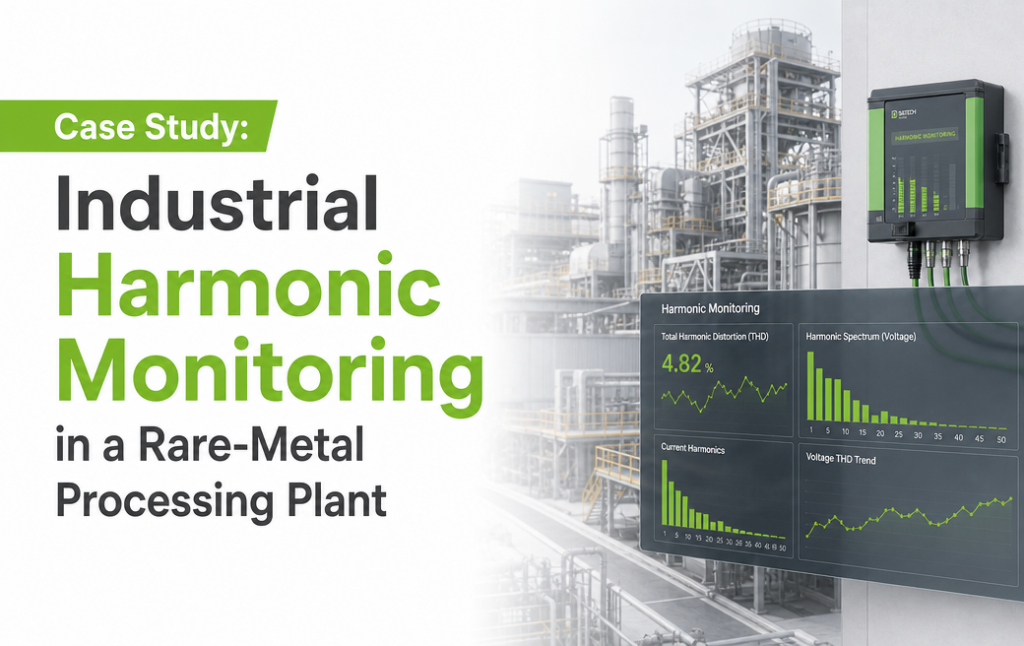
Industrial harmonic monitoring can reveal when harmonics occur, how serious they are, and which operating conditions make them worse. Simply knowing that harmonics exist is not enough to guide corrective action.
This was the situation at a rare-metal processing plant using large electric furnaces and other three-phase industrial loads. The site had high operating temperatures, substantial power demand, and multiple nonlinear loads. The customer was already aware that harmonics were present, but without continuous measurement, the problem remained difficult to quantify.
After installing a PEM3000 three-phase power meter, the team was able to verify the current measurement configuration, view harmonic data up to the 50th order, and turn a general concern into measurable information.
The case shows where a power meter with practical power-quality functions can add value: not as a replacement for a professional Class A power-quality analyzer, but as a permanently installed monitoring tool for finding abnormal conditions, supporting further analysis, and verifying improvements over time.
The Industrial Harmonic Monitoring Challenge
Rare-metal processing is energy intensive. Large metal furnaces and associated production equipment can create rapidly changing load conditions. Power electronic equipment and other nonlinear loads may also distort current and voltage waveforms, producing harmonics in the electrical system.
These conditions can contribute to additional electrical losses, temperature rise, equipment stress, and operational instability. However, the effect cannot be understood from assumptions alone. The plant needs actual data showing the harmonic levels, the dominant orders, and the operating periods in which they occur.
Portable instruments are valuable for spot checks and detailed troubleshooting. But a short measurement window may not show what happens during different production cycles, load changes, or equipment combinations. This plant therefore needed continuous industrial harmonic monitoring under real operating conditions.
The First Finding: A Measurement Configuration Mismatch
After the PEM3000 was installed, the current measured by the meter differed from the reading of a Fluke reference instrument by approximately 20–30 A.
The team first checked the wiring and other basic configuration items. They then reviewed the rated-current setting used for the Rogowski coils. The configured values were around 600 A or 800 A, while the installed coils required settings of 1000 A or 1200 A.
After the correct coil ratings were entered, the current readings returned to the expected range.
This was an important first step. When a meter is used with external current sensors, the sensor ratio or rated-current setting must match the actual device. Otherwise, even a correctly installed system can display scaled values that do not represent the real load.
The Bigger Finding: Harmonic Levels Were Higher Than Expected
Once the measurement configuration had been verified, the customer reviewed the harmonic data from the plant.
The result was more significant than the initial current discrepancy. Harmonic levels were considerably higher than the customer had expected.
The plant team already knew that furnaces and other nonlinear loads could introduce harmonics. What they did not know was the actual severity. With the meter installed, they could begin to answer practical questions:
- Which harmonic orders are most significant?
- Do harmonic levels rise when a particular furnace or production line starts?
- Are the readings consistently high or limited to specific operating periods?
- How do harmonics change with current, power factor, demand, and total energy consumption?
The problem was no longer described simply as “we have harmonics.” It could now be viewed as data and compared across operating conditions.
From Industrial Harmonic Monitoring to Corrective Action
Measurement does not remove harmonics by itself. Its value is that it helps the plant decide where to investigate and what action may be justified.
Based on the recorded results, the customer could work with its equipment supplier or a specialist power-quality company to examine the main harmonic sources. Possible next steps might include adjusting equipment parameters, changing operating sequences, reviewing power-factor correction equipment, or evaluating suitable harmonic mitigation devices.
The meter can then remain in place to establish a simple improvement cycle:
- Measure the baseline. Record harmonics, current, power factor, demand, and energy use under normal operating conditions.
- Identify abnormal patterns. Compare the data with production schedules and equipment operation.
- Make a targeted adjustment. Optimize settings, operating methods, or power-quality equipment based on specialist recommendations.
- Measure again. Compare the same parameters before and after the change.
- Verify the result. Confirm whether harmonic levels, electrical stress, or energy performance has improved.
This measure–adjust–verify process helps turn power-quality improvement from a one-time intervention into an ongoing operational practice.
Does Reducing Harmonics Always Reduce the Electricity Bill?
Not necessarily, and this distinction matters.
High harmonic levels can increase RMS current, additional losses, and heating in cables, transformers, motors, and other electrical equipment. Reducing harmonics may therefore improve operating conditions and reduce avoidable electrical stress.
However, a lower harmonic level does not automatically produce a large or immediate reduction in the electricity bill. Actual energy savings may also come from:
- optimizing equipment parameters;
- improving production schedules or load management;
- reducing unnecessary peak demand;
- improving power factor where relevant;
- correcting abnormal equipment operation; and
- reducing losses within the electrical distribution system.
For this reason, the most reliable approach is to monitor several parameters together. Harmonics provide one part of the picture. Current, active power; power factor; demand; and energy consumption help show whether an operational change has produced a broader improvement.
Why Use a Permanently Installed Meter for Industrial Harmonic Monitoring?
A portable professional analyzer remains the right tool for compliance testing, detailed diagnostics, and investigations that require high measurement performance, event capture, or waveform analysis.
A permanently installed meter serves a different purpose. It gives the plant ongoing visibility during real production, including conditions that may not occur during a short site visit.
For industrial users, this can provide several practical benefits:
- Continuous visibility: Observe how electrical conditions change across shifts, batches, and production cycles.
- Earlier warning: Identify unusual trends before they become obvious equipment or production problems.
- Better specialist input: Provide historical data to an energy consultant or power-quality solution provider before detailed site testing.
- Post-improvement verification: Compare the same measurements after equipment settings or mitigation measures are changed.
- Combined energy and power-quality monitoring: Review harmonics together with load, demand, power factor, and consumption data.
The objective is not to replace specialist analysis. It is to make specialist work more focused and give the plant a continuous view before and after that work takes place.
How PEM3000 Supports Industrial Harmonic Monitoring
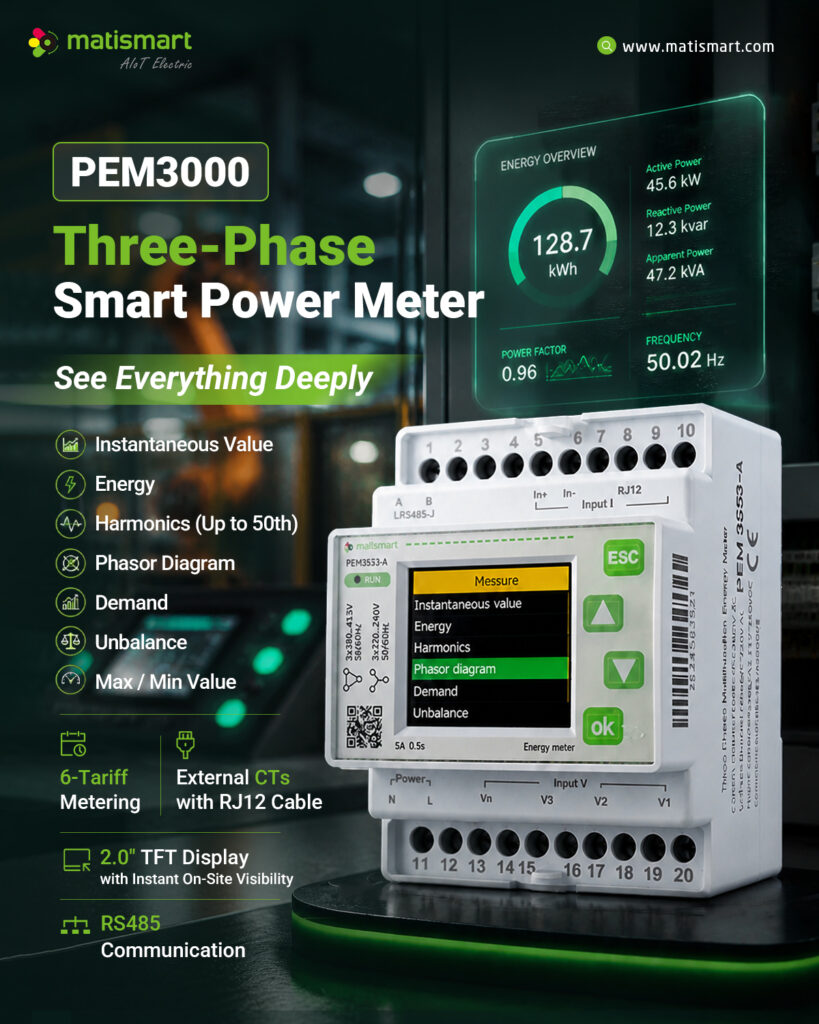
PEM3000 is designed for three-phase electrical monitoring in industrial and commercial power systems. In this application, its value came from combining standard energy measurements with practical power-quality visibility in one installed device.
Relevant monitoring functions include:
- three-phase voltage and current;
- active, reactive and apparent power;
- power factor and frequency;
- demand and energy consumption; and
- harmonic measurement up to the 50th order.
When used with correctly selected and configured current sensors, the meter can provide ongoing data for plant operators, system integrators, and power-quality service companies.
PEM3000 is not positioned as a professional Class A power-quality analyzer for regulatory reporting or forensic diagnosis. It is a practical choice when the goal is to add continuous harmonic and energy visibility to a three-phase installation, identify trends, and support data-based operational decisions.
Where This Monitoring Approach Can Be Used
The same approach can be relevant in other facilities with large or nonlinear loads, including:
Metal Processing and Electric Furnace Facilities
Monitor load changes, harmonic trends, power factor, and demand during different furnace operating stages.
Factories with Variable-Frequency Drives
Observe harmonic patterns associated with motors, pumps, compressors, and production equipment controlled by drives.
Welding and High-Current Production Lines
Compare electrical conditions during intermittent high-load processes and different operating combinations.
Industrial Plants Planning Harmonic Mitigation
Collect baseline data before installing filters or making system changes, then verify performance after implementation.
A Practical Path from an Invisible Problem to Measurable Improvement
The main lesson from this case is simple: an electrical issue cannot be managed effectively if it is only assumed.
At this plant, continuous monitoring first helped uncover a sensor-configuration mismatch. It then showed that the harmonic condition was more serious than expected. The customer gained a measurable baseline that could be shared with equipment suppliers or power-quality specialists and used to evaluate the next corrective step.
The value follows a clear path:
Measure the problem → use the data to adjust → measure again → verify the improvement
At this plant, industrial harmonic monitoring first helped uncover a sensor-configuration mismatch. It then showed that the harmonic condition was more serious than expected. The customer gained a measurable baseline that could be shared with equipment suppliers or power-quality specialists and used to evaluate the next corrective step.
Suggested FAQs:
Can an energy meter detect industrial harmonics?
An energy meter with harmonic measurement functions can help identify harmonic levels, dominant orders, and operating trends. It is useful for continuous monitoring, but it does not replace a professional power-quality analyzer when certified compliance measurements or advanced fault diagnosis are required.
Why must the Rogowski coil rating be configured correctly?
The meter uses the configured coil rating to scale the measured signal. If that setting does not match the installed Rogowski coil, the displayed current can be higher or lower than the actual value.
Does lowering harmonics always reduce energy costs?
No. Lower harmonics can reduce additional losses, heating, and equipment stress, but the effect on the electricity bill depends on the installation. Energy savings may also result from equipment optimization, load management, demand reduction, and power-factor improvement.
Can PEM3000 replace a Class A power-quality analyzer?
No, PEM3000 is not positioned as a professional class. A power-quality analyzer for regulatory reporting or forensic diagnosis. PEM3000 is intended for continuous operational monitoring of energy and harmonic trends. A professional Class A analyzer (methods defined by IEC 61000-4-30) should be used when regulatory compliance, certified reporting, or advanced diagnostic analysis is required.
Talk to Matismart About Your Application
If your facility operates electric furnaces, variable-frequency drives or other nonlinear three-phase loads, Matismart can help you evaluate whether PEM3000 is suitable for continuous energy and industrial harmonic monitoring.
Share your system voltage, maximum current, current-sensor type, communication requirements, and monitoring objective with our team. We can help you select an appropriate configuration for your project. Contact Matismart today!