


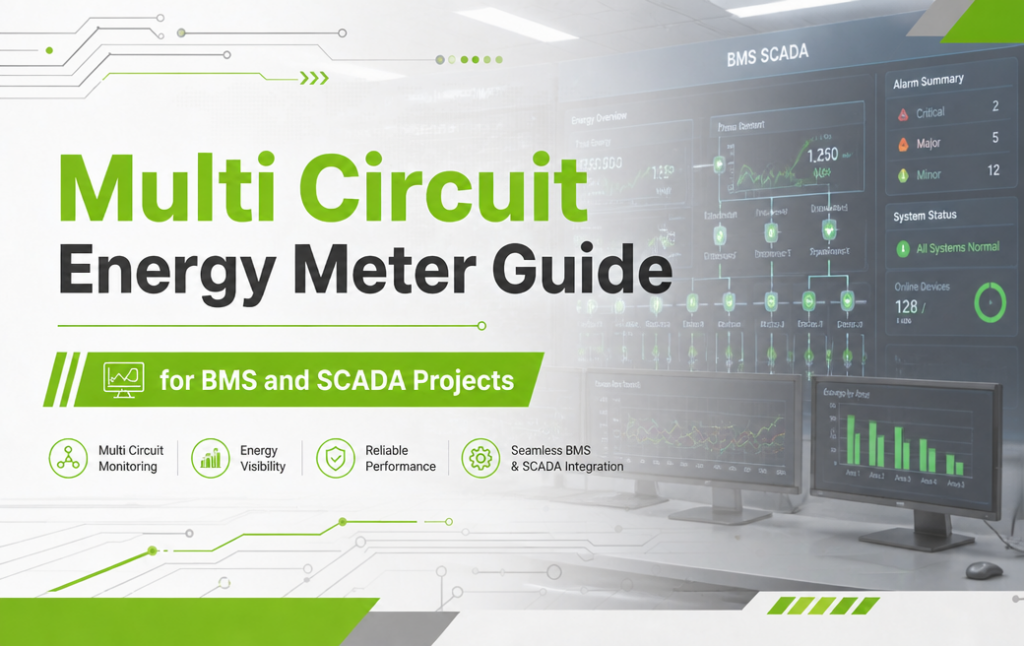
A multi circuit energy meter measures several electrical circuits through one centralized system instead of requiring a separate meter for every feeder. It gives system integrators circuit-level data while reducing panel space, wiring, communication addresses, and installation work.
This type of metering is especially useful in data centers, commercial buildings, industrial plants, and retrofit projects where many outgoing circuits need to be connected to an EMS, BMS, or SCADA platform.
For projects with different circuit quantities and monitoring requirements, Matismart provides two options: the modular Enertrek multi-circuit monitoring system and the compact MPM4000 multi-circuit power meter.
What Is a Multi Circuit Energy Meter
A multi circuit energy meter uses one central measuring unit or modular monitoring system to collect electrical data from several outgoing circuits.
Depending on the design, it can measure the following:
- Voltage
- Current
- Active and reactive power
- Power factor
- Active and reactive energy
- Demand
- Frequency
- Harmonics and THD
- Circuit or terminal temperature
- Alarm status
The collected data can then be transmitted to a local display, gateway, PLC, BMS, SCADA, or energy management platform.
Unlike a basic three-phase meter that normally monitors one feeder, a multi-circuit power meter is designed to monitor multiple independent loads from one location.
Why Use Multi Circuit Metering Instead of Separate Meters
Installing one conventional meter for every circuit may look simple at first. However, the design becomes more complicated as the number of circuits increases.
| Project Consideration | Individual Energy Meters | Multi Circuit Energy Meter |
| DIN rail space | One device per circuit | Centralized or modular structure |
| Voltage wiring | Repeated for every meter | Shared or centralized voltage measurement |
| Communication | Multiple addresses and cables | Centralized data collection |
| Installation | More devices and terminals | Fewer devices and simpler wiring |
| Expansion | Additional meters required | Modules or channels can be added |
| System integration | Each meter must be configured | One system or communication point |
| Retrofit work | May require more panel modification | Split-core sensors can simplify installation |
The main benefit is not only reducing the number of meters. A well-designed multi-circuit solution also simplifies engineering, commissioning, and future maintenance.
Where Multi Circuit Energy Meters Are Commonly Used
Data Centers
Data centers contain many outgoing feeders across PDUs, RPPs, Tou Boxes and distribution panels. Circuit-level monitoring helps operators understand load distribution, available capacity, and abnormal consumption.
A multi circuit energy meter can send feeder data to an EPMS, DCIM, BMS or SCADA system through an open communication protocol.
Commercial Buildings
Commercial buildings often need to monitor energy use by floor, tenant, equipment group or distribution board. Multi-circuit metering provides more detailed data without filling the panel with individual meters.
It can support internal energy allocation and efficiency analysis. If the data will be used for legal tenant billing, the project must also verify local metering and certification requirements.
Industrial Facilities
Factories can use circuit-level data to compare production lines, equipment groups or operating shifts. This helps identify load changes, abnormal demand and possible power quality issues.
Retrofit Projects
Existing panels may have limited space and cannot easily accommodate many new meters. Split-core CTs, Rogowski coils and compact sensors can reduce modification work.
Non-invasive current sensing may also reduce or avoid shutdown during sensor installation. The final installation method must still follow the project design and local electrical safety procedures.
What to Check When Selecting a Multi Circuit Energy Meter
1. Circuit Quantity and Phase Configuration
First confirm how many circuits must be monitored and whether they are single-phase, three-phase or mixed.
A project with four critical three-phase feeders needs a different architecture from a panel containing dozens of mixed branch circuits.
2. Current Range and Sensor Type
Check the current rating of every circuit and the available installation space.
Common sensing options include:
- Integrated current sensors
- Solid-core CTs
- Split-core CTs
- Rogowski coils
- External 1A or 5A CTs
Split-core CTs and Rogowski coils are usually easier to apply in retrofit projects because the existing conductor does not need to pass through a closed CT.
3. Measurement Accuracy
Accuracy should match the purpose of the project.
Energy management and operational monitoring may have different requirements from regulated billing. For reference, IEC 62053-22 defines requirements for transformer-operated static active energy meters in accuracy classes including Class 0.5S.
However, an accuracy class alone does not automatically mean that a meter is approved for legal billing in every country. Local MID, utility or revenue-metering requirements may also apply.
4. Communication with BMS and SCADA
For system integration, confirm:
- Physical interface
- Communication protocol
- Register map
- Baud rate and device addressing
- Data type and byte order
- Maximum devices on the network
- Required polling interval
- Alarm and control functions
Modbus RTU over RS485 remains common in BMS, PLC and SCADA projects. Modbus TCP allows the meter to communicate through Ethernet. The official Modbus specifications provide further information about the protocol and implementation.
5. Local and Remote Data Requirements
Not every project needs a cloud platform.
Some customers only require:
- Local display
- Local web access
- PLC communication
- BMS integration
- SCADA monitoring
- On-premises data storage
Other projects require MQTT, Ethernet, WiFi, or 4G communication to send data to a remote IoT platform. The communication architecture should be selected according to the customer’s existing system.
Enertrek for Scalable Multi Circuit Energy Monitoring
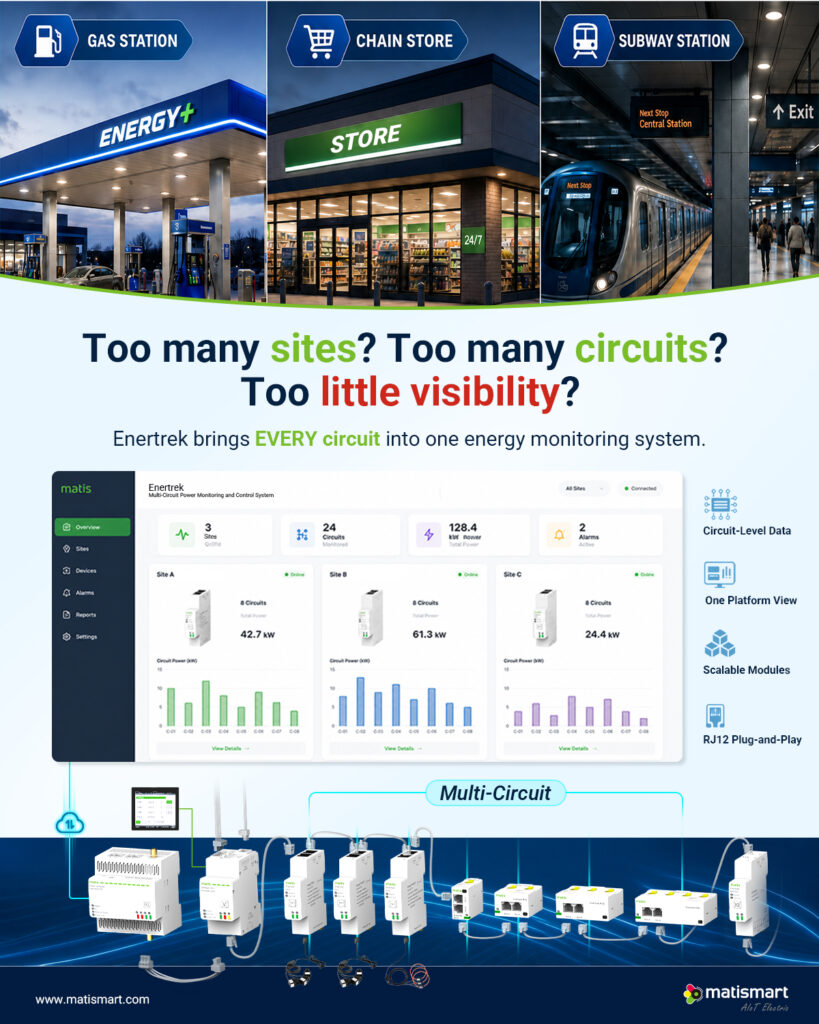
The Matismart Enertrek system is a modular multi circuit energy meter solution designed for projects that require flexible branch monitoring and future expansion.
Instead of using one fixed meter with a limited number of channels, Enertrek combines voltage, current, energy, I/O and communication modules according to the project architecture.
Its main components include:
Enertrek V10 Voltage Unit
The V10 provides centralized voltage and frequency measurement. It also supports voltage harmonic analysis and supplies power to downstream Enertrek submodules.
One V10 can connect multiple monitoring modules through the Enertrek bus, allowing the system to expand according to the number of circuits.
Enertrek M Series Energy Sensors
The M10, M20, M30 and M40 modules are designed for small-current branch monitoring.
Depending on the model, they support the following:
- Single-phase and three-phase circuits
- One to four poles
- Current measurement up to 60A
- Class 0.5 energy measurement
- Integrated current sensing
- Temperature detection
- Compact installation beside existing breakers
This configuration is useful when a project needs detailed monitoring of many MCB outgoing circuits.
Enertrek E Series Measurement Modules
For higher-current feeders, Enertrek can work with external current transformers and different sensor configurations. This allows the same system to cover both small branch circuits and larger incoming or outgoing feeders.
Enertrek G30 Gateway
The Enertrek G30 gateway collects device data and connects the hardware layer to the customer’s software system.
It supports:
- Modbus
- MQTT
- SNMP
- IEC 104
- RS485
- Ethernet
- WiFi
- 4G
- Local web configuration
- Offline data storage
Enertrek is therefore best suited to projects where the number and type of circuits may vary, especially in retrofit panels, data centers, commercial buildings, and multi-site energy monitoring projects.
MPM4000 for 4 Three-Phase Circuits or 12 Single-Phase Circuits
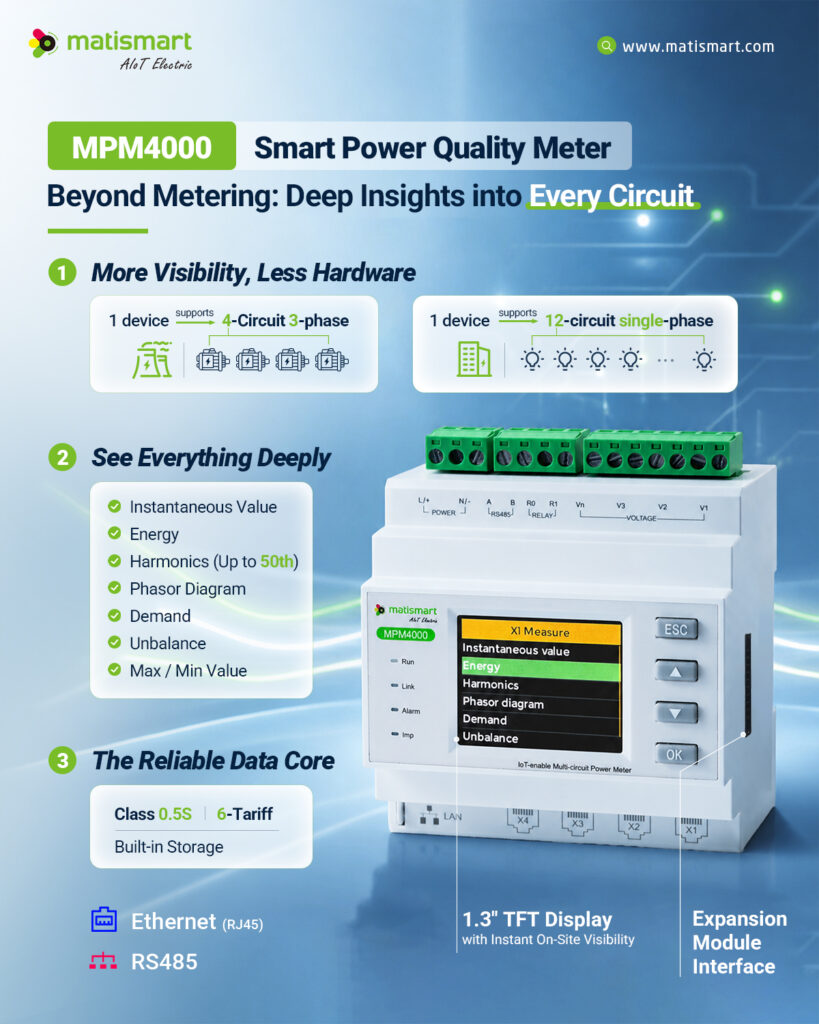
The Matismart MPM4000 is a compact multi-circuit multifunction power meter designed to monitor up to four three-phase circuits through one device.
Its main capabilities include:
- Monitoring of up to four three-phase circuits
- Class 0.5S active energy accuracy
- Voltage and current harmonic analysis up to the 50th order
- Demand, max/min value, and power factor monitoring
- Six-tariff energy metering
- Configurable alarm functions
- RS485 with Modbus RTU
- Ethernet with Modbus TCP
- Built-in data storage
- Rogowski coil or split-core CT options
- Local TFT display
The MPM4000 is suitable when the project contains a limited number of important three-phase feeders and requires detailed electrical data from a single compact device.
Typical applications include the following:
- Data center distribution cabinets
- Industrial production lines
- Commercial building feeders
- Smart electrical panels
- Critical equipment monitoring
Its harmonic measurement functions provide useful visibility for internal power monitoring and troubleshooting. The MPM4000 should not be described as an IEC 61000-4-30 Class A or Class S power quality analyzer unless the required certification is specifically confirmed.
Enertrek or MPM4000: Which One Should You Choose
| Selection point | Enertrek | MPM4000 |
| Architecture | Modular and scalable monitoring system | Integrated multi-circuit meter |
| Best circuit type | Mixed branch circuits | Up to 4 three-phase circuits or 12 single-phase circuits |
| Expansion | Modules can be added | Fixed channel capacity |
| Small-current monitoring | Integrated compact sensors available | External CT or Rogowski coil |
| High-current monitoring | External CT modules available | Split-core CT or Rogowski coil |
| Communication | Modbus, gateway-based MQTT, SNMP, and IEC 104 | Modbus RTU and Modbus TCP |
| Local display | Through Enertrek D10 or platform | Built-in TFT display |
| Harmonic visibility | Up to the 50th harmonic only with E21/31 | Up to the 50th harmonic |
| Best application | Large or expandable branch monitoring | Detailed monitoring of several critical feeders |
| Retrofit suitability | High | High with suitable current sensors |
Choose Enertrek when:
- The project contains many circuits
- Single-phase and three-phase circuits are mixed
- Future expansion is expected
- Compact branch-level monitoring is required
- A gateway is needed to connect meters and devices to an IoT platform
- The system must adapt to different panel designs
Choose MPM4000 when:
- The project has up to four three-phase feeders
- A single integrated meter is preferred
- Local display and direct Ethernet communication are required
- Detailed demand and harmonic data are important
- The application requires a compact multifunction meter
Can Enertrek and MPM4000 Be Used in the Same Project?
Yes. A project does not always need to choose only one multi circuit energy meter.
For example:
- MPM4000 can monitor several critical three-phase incoming or distribution feeders
- Enertrek can monitor a larger number of downstream branch circuits
- G30 can aggregate meter and device data
- The customer’s BMS, SCADA, or EMS can receive the required data through Modbus, MQTT, or another supported interface
This layered architecture provides detailed monitoring without forcing every circuit to use the same type of meter.
Typical Integration Architecture
A multi-circuit monitoring project normally follows this data path:
Current sensors and voltage inputs
to
Enertrek or MPM4000
to
RS485 Ethernet or G30 gateway
to
PLC, BMS, SCADA, EMS, or IoT platform
Before installation, the system integrator should confirm the register map, communication topology, circuit naming method, and data update interval.
This work is part of the design in process. It helps ensure that the selected hardware can be integrated into the final system before equipment is ordered and installed.
Frequently Asked Questions
How is a multi-circuit energy meter different from a normal energy meter?
A normal energy meter usually monitors one single-phase or three-phase feeder. A multi circuit energy meter monitors several independent circuits through one device or one modular system.
Can a multi circuit meter connect to a BMS or SCADA system?
Yes. Products with Modbus RTU, Modbus TCP or another open protocol can be integrated into many BMS, PLC, and SCADA systems. The system integrator should verify the communication register map and network configuration.
Can it be installed without shutting down the panel?
Split-core CTs and Rogowski coils can reduce the need to disconnect existing conductors. However, voltage connections and other installation work must be assessed by qualified electrical personnel according to local safety requirements.
How many circuits can one meter monitor?
The capacity depends on the product architecture. The MPM4000 monitors up to four three-phase circuits or 12 single-phase circuits. Enertrek uses a scalable modular structure for projects with more circuits and mixed feeder types.
Can it measure power quality?
Both the Enertrek and MPM4000 provide harmonics, THD, demand, and unbalance information. General harmonic monitoring should not be confused with compliance-grade Class A or Class S power quality measurement.
Can the data be stored locally?
Yes, depending on the selected device. The MPM4000 includes internal data storage. The Enertrek G30 gateway also supports offline storage and local web access.
Can multi-circuit metering be used for tenant billing?
It can provide circuit-level energy data for allocation and analysis. Legal tenant billing may require specific MID, utility, or local revenue-metering approval. This must be confirmed for the country and project.
Which solution is better for retrofit projects?
Enertrek is normally more flexible when many existing branch circuits must be monitored. MPM4000 is suitable when the project needs detailed monitoring of up to four three-phase feeders. The final selection depends on panel space, circuit quantity, current range, and integration requirements.
Build the Right Multi Circuit Monitoring Architecture
The right solution depends on more than the number of measurement channels.
System integrators should also consider panel structure, circuit current, sensor type, accuracy, communication protocol, local data requirements, and future expansion.
Matismart supports design in cooperation for both Enertrek and MPM4000. We can help review the circuit list, recommend a hardware architecture, provide communication documents, and support integration testing before project deployment.
Contact Matismart with your single-line diagram, circuit quantity, current range, and required communication protocol to discuss a suitable multi-circuit monitoring solution.